Not Even A Hint Joshua Harris Pdf Free Download
| Divine | |
|---|---|
 Divine in a publicity photograph from the 1980s | |
| Born | Harris Glenn Milstead (1945-10-19)October 19, 1945 Baltimore, Maryland, U.S. |
| Died | March 7, 1988(1988-03-07) (aged 42) Los Angeles, California, U.S. |
| Resting place | Prospect Colina Cemetery (Towson, Maryland) |
| Occupation | Actor, singer, drag queen |
| Years active | 1966–1988 |
| Website | divineofficial |
Harris Glenn Milstead (Oct 19, 1945 – March seven, 1988), better known by his stage proper name Divine, was an American thespian, vocalist, and drag queen. Closely associated with independent filmmaker John Waters, Divine was a grapheme player, usually performing female roles in cinematic and theatrical productions, and adopted a female person drag persona for his music career.
Born in Baltimore, Maryland to a bourgeois eye-form family, Milstead adult an early interest in drag while working equally a women's barber. By the mid-1960s he had embraced the urban center'south countercultural scene and befriended Waters, who gave him the proper name "Divine" and the tagline of "the most beautiful woman in the world, most." Along with his friend David Lochary, Milstead joined Waters' interim troupe, the Dreamlanders, and adopted female roles for their experimental short films Roman Candles (1966), Eat Your Makeup (1968), and The Diane Linkletter Story (1969). Again in drag, he took a lead function in both of Waters' early full-length movies, Mondo Trasho (1969) and Multiple Maniacs (1970), the latter of which attracted press attention for the grouping. Milstead side by side starred in Waters' Pink Flamingos (1972), which was a hit on the U.S. midnight movie circuit, became a cult classic, and established Milstead's fame in the American counterculture.
Afterwards starring as the pb role in Waters' next flick, Female Trouble (1974), Divine moved on to theater, actualization in several avant-garde performances aslope San Francisco elevate collective, The Cockettes. He followed this with a performance in Tom Eyen's play Women Behind Bars and its sequel, The Neon Adult female. Continuing his cinematic work, he starred in two more than of Waters' films, Polyester (1981) and Hairspray (1988), the latter of which represented his quantum into mainstream cinema and for which he was nominated for the Contained Spirit Award for All-time Supporting Male. Independent of Waters, he also appeared in a number of other films, such equally Animalism in the Dust (1985) and Trouble in Listen (1985), seeking to diversify his repertoire by playing male roles. In 1981, Divine embarked on a career in the disco industry by producing a number of Howdy-NRG tracks, most of which were written by Bobby Orlando. He accomplished international chart success with hits similar "You Call back You're a Man", "I'k So Cute", and "Walk Like a Man", all of which were performed in drag. Divine had a condition called cardiomegaly. Stress on his enlarged centre led to a center assault that killed him before long after the release of Hairspray.
Described by People magazine every bit the "Drag Queen of the Century",[1] Divine has remained a cult figure, particularly within the LGBT community, and has provided the inspiration for fictional characters, artworks, and songs. Diverse books and documentary films devoted to his life have also been produced, including Divine Trash (1998) and I Am Divine (2013).
Early on life [edit]
Youth: 1945–1965 [edit]
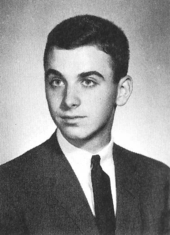
Glenn "Divine" Milstead's high school yearbook photo at historic period 17[ii]
Milstead was born on October xix, 1945 at Women's Hospital in Baltimore, Maryland.[3] His father, Harris Bernard Milstead (May 1, 1917 – March 4, 1993), afterward whom he was named, was one of seven children built-in in Towson, Maryland to a plumber who worked for the Baltimore City Water Department.[four] Divine'due south mother, Frances Milstead (née Vukovich; April 12, 1920 – March 24, 2009), was one of 15 children born to an impoverished Serb immigrant couple who had grown upwardly near Zagreb (in today's Croatia) before moving to the United States in 1891.[5] [6] When she was sixteen, she moved to Baltimore where she worked at a diner in Towson where she met Harris, a regular customer. After marrying in 1938, they were both hired at the Blackness & Decker factory in Towson. Due to muscular dystrophy, Harris was non required to bring together the U.S. armed forces in the Second World War; instead, he and Frances worked through the war years in what they considered "proficient jobs".[7] Frances suffered two miscarriages in 1940 and 1943.[6] [8]
By the time of Divine's birth in 1945, the Milsteads were affluent and socially conservative Baptists.[9] Describing his upbringing, Divine recollected: "I was an merely child in, I guess, your upper middle-course American family. I was probably your American spoiled brat."[9] His parents lavished almost annihilation that he wanted on him, including food, and he became overweight, a condition he lived with for the rest of his life.[x] On his request, his parents and friends chosen him by his middle proper noun, Glenn, to distinguish him from his male parent.[11]
At age 12, Divine and his parents moved to the Baltimore suburb of Lutherville, where he attended Towson High School, graduating in 1963.[12] [13] Bullied because of his weight and perceived effeminacy,[fourteen] he afterward reminisced that he "wasn't crude and tough" but instead "loved painting and I always loved flowers and things."[12] At 15 he took a part-time job at a local florist's shop.[15] Several years afterwards, he went on a nutrition and skinned downward from 180 to 145 pounds (82 to 66 kg), giving him new confidence.[15] When he was 17, his parents sent him to a psychiatrist, where he first realized his sexual allure to men as well equally women, something then taboo in conventional American society.[xvi] He helped out at his parents' twenty-four hours care business organization, including dressing up as Santa Claus to entertain the children at Christmas time.[17] In 1963, he began attention the Marinella Beauty School, where he learned hair styling and, after completing his studies, gained employment at a couple of local salons, specializing in the creation of beehives and other upswept styles.[16] [xviii] He eventually gave up the job and for a while was financially supported by his parents, who catered to his expensive taste in clothes and cars. They reluctantly paid the many bills he ran up throwing lavish parties where he dressed in elevate equally his favorite celebrity, actress Elizabeth Taylor.[19] [20]
John Waters and Divine's offset films: 1966–1968 [edit]
Milstead developed a large coterie of friends, among them David Lochary, who became an thespian and costar in several of Divine's later films.[21] [22] In the mid-1960s, Milstead befriended John Waters through their mutual friend Carol Wernig; Waters and Milstead were the same age and from the same neighborhood, and both embraced Baltimore's countercultural and surreptitious elements.[half dozen] [23] [24] Along with friends like Waters and Lochary, Milstead began hanging out at a beatnik bar in downtown Baltimore named Martick'south, where they associated with hippies and smoked marijuana, bonding into what Waters described as "a family of sorts".[23] Waters gave his friends new nicknames, and it was he who offset called Milstead "Divine". Waters after remarked that he had borrowed the proper noun from a character in Jean Genet's novel Our Lady of the Flowers (1943), a controversial book about homosexuals living on the margins of Parisian society, which Waters – himself a homosexual – was reading at the time.[25] Waters besides introduced Divine as "the near beautiful woman in the world, almost", a description widely repeated in ensuing years.[25]
"Divine. That's my name. Information technology's the proper noun John [Waters] gave me. I like it. That's what everybody calls me now, even my close friends. Not many of them phone call me Glenn at all anymore, which I don't listen. They can call me any they want. They phone call me fatso, and they call me asshole, and I don't care. You lot ever modify your proper noun when you're in the show business. Divine has stuck as my proper name. Did you e'er look it up in the lexicon? I won't fifty-fifty go into it. It's unbelievable."
— Divine, 1973[26]
Waters was an aspiring filmmaker, intent on making "the trashiest motion pictures in movie house history".[27] Many of his friends, a grouping which came to be known equally "the Dreamlanders" (and who included Divine, Lochary, Mary Vivian Pearce and Mink Stole), appeared in some of his low-upkeep productions, filmed on Dominicus afternoons.[27] Following the production of his starting time short film, Hag in a Black Leather Jacket (1964), Waters began production of a second piece of work, Roman Candles (1966). This flick was influenced by the pop artist Andy Warhol'southward Chelsea Girls (1966), and consisted of 3 8-millimeter movies played simultaneously adjacent. Roman Candles was the get-go pic to star Divine, in this instance in elevate every bit a smoking nun. It featured the Dreamlanders modeling shoplifted apparel and performing various unrelated activities.[27] [28] [29] Existence both a short moving-picture show and of an advanced nature, Roman Candles never received widespread distribution, instead holding its premiere at the almanac Mt. Vernon Flower Mart in Baltimore, which had become pop with "elderly dames, young faggots and hustlers, and of course a whole bunch of hippies".[xxx] Waters went on to screen information technology at several local venues alongside Kenneth Anger's short flick Eaux d'Artifice (1953).[xxx]
Waters followed Roman Candles with a third short movie, Eat Your Makeup (1968), in which Divine once more wore drag, this fourth dimension to portray a fictionalized version of Jackie Kennedy, the widow of recently assassinated U.South. President John F. Kennedy. In the film, she turns to kidnapping models and forcing them to swallow their own makeup.[31] [32] Divine kept his interest with Waters and these early surreptitious films a underground from his conservative parents, assertive that they would not understand them or the reason for his involvement in such controversial and bad-taste films; they would non observe out most them for many years.[33] [34] Divine's parents had bought him his own beauty store in Towson, hoping that the financial responsibility would help him to settle down in life and stop spending so extravagantly. While like-minded to work at that place, he refused to be involved in owning and managing the establishment, leaving that to his mother.[35] Not long after, in the summer of 1968, he moved out of his parental home, renting his own apartment.[36]
The Diane Linkletter Story, Mondo Trasho, and Multiple Maniacs: 1969–1970 [edit]
Divine appeared in Waters's adjacent brusque film, The Diane Linkletter Story (1969), which was initially designed to be a test for a new sound camera. A blackness one-act that carried on in Waters'due south tradition of making "bad taste" films to shock conventional American society, The Diane Linkletter Story was based upon the true story of Diane Linkletter, the girl of media personality Art Linkletter, who had committed suicide earlier that yr. Her death had led to a flurry of media interest and speculation, with various sources erroneously claiming that she had washed so under the influence of the psychedelic LSD. Waters's dramatized version starred Divine in the leading role as the teenager who rebels against her conservative parents after they effort to break up her relationship with hippie swain Jim, before consuming a large quantity of LSD and committing suicide. Although screened at the first Baltimore Picture show Festival, the film was non publicly released at the time, largely for legal reasons.[31] [37]
Soon after the production of The Diane Linkletter Story, Waters began filming a full-length motion picture show, Mondo Trasho, starring Divine every bit 1 of the main characters, an unnamed blonde woman who drives effectually town and runs over a hitchhiker.[38] [39] In one scene, an actor was required to walk along a street naked, which was a crime in the state of Maryland at the time, leading to the arrest of Waters and most of the actors associated with the film; Divine escaped, having speedily driven away from the constabulary when they arrived to carry out the arrests.[forty] In their review of the film, the Los Angeles Gratis Press exclaimed that "The 300-pound (140 kg) sexual activity-symbol Divine is undoubtedly some sort of discovery."[41]
In 1970, Divine abandoned piece of work equally a barber, opening upwardly a vintage clothing store in Provincetown, Massachusetts using his parents' money. Opening in 1970 equally "Divine Trash", the store sold items that Divine had purchased in thrift stores, flea markets and garage sales, although information technology had to motion from its original location after he had failed to obtain a license from the local authorities.[31] [42] Realizing that this venture was not financially viable, Divine sold off his stock at very low prices. In the promise of raising some extra coin, he sold the piece of furniture of his rented, furnished apartment, leading the landlady to put out a warrant for his arrest.[43] [44] He evaded the local constabulary by traveling to San Francisco, California, a metropolis which had a large gay subculture that attracted Divine, who was so embracing his homosexuality.[45]
In 1970, Divine played the role of Lady Divine, the operator of an exhibit known as The Cavalcade of Perversion who turns to murdering visitors in Waters's picture Multiple Maniacs. The film independent several controversial scenes, notably one which involved Lady Divine masturbating using a rosary while sitting inside a church. In some other, Lady Divine kills her boyfriend and proceeds to eat his heart; in authenticity, Divine bit into a moo-cow's heart which had gone rotten from existence left out on the set all day. At the end of the motion picture, Lady Divine is raped by a giant lobster named Lobstora, an human action that drives her into madness; she subsequently goes on a killing spree in Fell'due south Point before being shot downward by the National Baby-sit.[46] [47] [48] Due to its controversial nature, Waters feared that the picture show would be banned and confiscated by the Maryland State Board of Censors, and so avoided their jurisdiction by only screening it at non-commercial venues, namely rented church bounds.[49] Multiple Maniacs was the outset of Waters'south films to receive widespread attention, equally did Divine; KSFX remarked that "Divine is incredible! Could start a whole new trend in films."[46]
Rise to fame [edit]
Pink Flamingos: 1971–1972 [edit]
Post-obit his San Francisco stay, Divine returned to Baltimore and participated in Waters's side by side film Pink Flamingos. Designed by Waters to exist "an exercise in poor taste,"[50] the pic featured Divine as Babs Johnson, a woman who claims to be "the filthiest person live" and who is forced to evidence her right to the title from challengers, Connie (Mink Stole) and Raymond Marble (David Lochary).[51] In one scene, the Marbles send Babs a turd in a box as a birthday nowadays, and in order to enact this scene, Divine defecated into the box the nighttime before.[52] Filmed in a hippie commune in Phoenix, Maryland, the cast members spent much of the time smoking cigarettes and marijuana and taking amphetamines. All of the scenes had been heavily rehearsed beforehand.[53] The final scene in the motion picture proved particularly infamous, involving Babs eating fresh dog carrion; Divine later on told a reporter, "I followed that dog around for iii hours only zooming in on its asshole," waiting for it to empty its bowels so that they could motion picture the scene.[54] The scene became ane of the most notable moments of Divine's acting career, and he after complained of people thinking that "I run around doing information technology all the fourth dimension. I've received boxes of domestic dog shit – plastic dog shit. I take gone to parties where people but sit down around and talk about dog shit because they think it'south what I want to talk nearly."[54] In reality, he remarked, he was not a coprophile only only ate excrement that i fourth dimension because information technology was in the script.[54] [55]
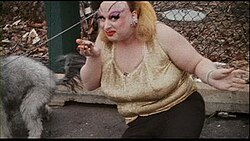
The scene at the terminate of Pink Flamingos, in which Divine (in character as Babs Johnson) consumes fresh domestic dog feces, became a significant part of American movie theatre history and dominated word of Divine and Waters' films for decades to come.
The film premiered in belatedly 1972 at the third Almanac Baltimore Film Festival, held on the campus of the University of Baltimore, where it sold out tickets for iii successive screenings; the film aroused particular involvement among underground movie house fans following the success of Multiple Maniacs, which had begun to be screened in New York City, Philadelphia, and San Francisco.[56] Existence picked up by the pocket-sized independent visitor New Line Movie house, Pink Flamingos was distributed to Ben Barenholtz, the owner of the Elgin Theater in New York City. At the Elgin Theater, Barenholtz had been promoting the midnight motion picture scene, primarily by screening Alejandro Jodorowsky's acrid western film El Topo (1970). Barenholtz felt that existence of an avant-garde nature, Pink Flamingos would fit in well with this crowd, screening it at midnight on Fri and Sat nights.[57] [58] The film shortly gained a cult following at the Elgin Theatre. Barenholtz characterized its early fans as primarily being "downtown gay people, more than of the hipper set," but afterward a while he noted that this group broadened, with the pic becoming popular with "working-class kids from New Jersey who would become a petty rowdy".[59] Many of these cult cinema fans learned all of the film's lines, reciting them at the screenings, a miracle which became associated with some other popular midnight movie of the era, The Rocky Horror Picture Show (1975).[59]
While keeping his involvement with Waters'southward hush-hush filmmaking a secret from his parents, Divine continued relying on them financially, charging them for expensive parties that he held and writing bad checks. Later he charged them for a major repair to his auto in 1972, his parents confiscated it from him and told him that they would non continue to back up him in such a style. In retaliation, he came by their business firm the following solar day, nerveless his two pet dogs and so disappeared, not seeing or speaking with them for the adjacent nine years. Instead, he sent them over fifty postcards from beyond the world, informing them that he was fine, but on none did he leave a return accost.[60] Frances and Harris Milstead retired soon later and moved to Florida at the advice of Harris's physician, who prescribed the southern state's warmer atmospheric condition as being benign for Harris's muscular dystrophy.[61]
Theater work and Female person Trouble: 1973–1978 [edit]
When the filming of Pink Flamingos finished, Divine returned to San Francisco, where he and Mink Stole starred in a number of minor-budget plays at the Palace Theater as part of elevate troupe The Cockettes, including Divine and Her Stimulating Studs, Divine Saves the World, Vice Palace, Journey to the Middle of Uranus and The Heartbreak of Psoriasis.[62] [63] [64] It was hither that he first met androgynous performer Sylvester.[65] Divine purchased a house in Santa Monica, which he furnished to his expensive tastes.[66] On visits to Washington D.C. during the early 1970s, Divine and Waters attended the metropolis's balls that were frequented by LGBT African-Americans. Hither, Waters encouraged Divine'due south drag persona to go more outrageous, exposing her overweight stomach and conveying weapons. He afterward commented that he wanted Divine to become "the Godzilla of drag queens",[67] a direct confrontation with the majority of Euro-American drag queens who wanted to be Miss America.[67] [68] In his individual life, Divine became the godfather of Beck Yeaton, the son of his friends Chuck Yeaton and Pat Moran; Brook and Divine remained very close until Divine's death.[69]
In 1974, Divine returned to Baltimore to film Waters's side by side motion picture, Female Trouble, in which he played the pb role. Divine'south character, teenage delinquent Dawn Davenport, embraces the thought that offense is fine art and is eventually executed in the electric chair for her vehement behavior.[seventy] [71] Waters claimed that the character of Dawn had been partly based on the mutual friend who had introduced him to Divine, Carol Wernig, while the costumes and make-upwardly were again designed by Van Smith to create the desired "trashy, slutty look."[72] In the film, Divine did his own stunts, including the trampoline scene, for which he had to undertake a number of trampolining lessons.[73] Divine as well played his first on-screen male role in the film, Earl Peterson, and Waters included a scene during which these two characters had sexual intercourse as a joke on the fact that both characters were played past the same actor. Female person Trouble proved to be Divine'southward favorite of his films, because it both allowed him to develop his character and to finally play a male role, something he had always felt of import because he feared beingness typecast every bit a female person impersonator.[73] [74] [75] Divine was also responsible for singing the theme melody for Female person Trouble, although information technology was never released as a single.[76] Divine remained proud of the picture show, although it received a mixed critical reception.[77]
In 1977, Divine co-starred in the revue Restless Underwear, aslope Canadian rock ring Crude Merchandise, which played at Massey Hall in Toronto. In 1980, the revue appeared at the Beacon Theater on Manhattan's Upper W Side. Bernard Jay, Divine's director, said that information technology was a "gigantic disaster", every bit Divine did not take equally large a part in the revue equally audience members expected.[78]
Divine was unable to announced in Waters's adjacent characteristic, Desperate Living (1977), despite the fact that the role of Mole McHenry had been written for him. This was because he had returned to working in the theater, this time taking the role of the scheming prison matron Pauline in Tom Eyen'southward comedy Women Behind Bars. Performed in New York City'due south Truck and Warehouse Theater, the play proved popular and was later taken to London's Whitehall Theater next to Trafalgar Square. Containing a new cast, it proved less successful than it had in New York.[79] [80] [81] It was in this city that Divine met a group of people whom he would come up to know equally his "London family": way designer Zandra Rhodes, photographer Robyn Beeche, sculptor Andrew Logan and the latter's partner, Michael Davis.[82] While in London in 1978, Divine attended as the guest of honour at the fourth Alternative Miss World pageant, a "mock" event founded past Logan in 1972 in which "drag queens" – including men, women and children – competed for the prize. The event was filmed by director Richard Gayer, whose subsequent film, entitled Alternative Miss World, premiered at the Odeon in London's Leicester Square likewise every bit featuring at the Cannes Film Festival, both events which were attended by Divine.[83]
Impressed with Divine's performance in Women Behind Confined, playwright Tom Eyen decided to write a new play that would feature him in a starring role. The result was The Neon Adult female, a story set in 1962 featuring Divine equally Wink Storm, the female owner of a Baltimore strip club. It played at the Hurrah! guild in New York City before moving on to the Alcazar Theatre in San Francisco. Divine remained very proud of the work, seeing it equally bear witness that his acting skills were coming to wider recognition, and his performances were attended by such celebrities as Eartha Kitt, Elton John, and Liza Minnelli.[84] [85] [86] It was during the New York leg of the play's tour that Divine befriended Jay Bennett; they subsequently began renting an apartment together on 58th Street. In the city, Divine assembled a group of friends that came to be known as his "New York family": designer Larry LeGaspi, makeup artist Conrad Santiago, Vincent Nasso, and dresser Frankie Piazza. While there, he frequented the famous club Studio 54, having a love of partying and club culture.[87]
Early disco work and Polyester: 1979–1983 [edit]
Divine somewhen decided to abandon his agent, Robert Hussong, and replace him with his English language friend Bernard Jay. Jay suggested that with his honey of clubs, Divine could obtain work performing in them; as a outcome, Divine first appeared in 1979 at a gay order in Fort Lauderdale, Florida, where his unscripted act included shouting "fuck you" repeatedly at the audience and then getting into a fight with another elevate queen, a gimmick that proved popular with the club'southward clientele. Subsequently, he saw the commercial potential of including disco songs in with his act and, with Tom Eyen and composer Henry Krieger, created "Born to exist Cheap" in 1981.[88] [89] In 1981 Divine appeared in John Waters's next moving picture, Polyester, starring as Francine Fishpaw. Unlike earlier roles, Fishpaw was non a strong female but a meek and victimized woman who falls in love with her dream lover, Todd Tomorrow, played by Tab Hunter. In real life, tabloid publications claimed a romantic connection between them, an exclamation both denied.[90] [91] The picture show was released in "Odorama", accompanied by "scratch 'n' sniff" cards for the audition to smell at fundamental points in the film.[92] Soon after Polyester, Divine auditioned for a male function in Ridley Scott's upcoming science-fiction movie Blade Runner. Even though Scott idea Divine unsuitable for the part, he claimed to exist enthusiastic about Divine's work and was very interested in including him in another of his films, merely ultimately this never came virtually.[93]
That same yr, Divine decided to become back in contact with his estranged parents. His mother had learned of his cinematic and disco career after reading an commodity about the films of John Waters in Life magazine, and had gone to see Female Trouble at the cinema, but had not felt emotionally able to get dorsum in contact with her son until 1981. She got a friend to hand Divine a note at one of his concerts, leading Divine to telephone her, and the family was subsequently reunited.[94] The relationship was mended, and Divine bought them lavish gifts and informed them of how wealthy he was. In fact, according to his manager Bernard Jay, he was already heavily in debt due to his extravagant spending.[95] In 1982, he then joined forces with young American composer Bobby Orlando, who wrote a number of Hello-NRG singles for Divine, including "Native Love (Step By Step)", "Shoot Your Shot", and "Love Reaction". To help publicize these singles, which proved to be successful in many discos beyond the earth, Divine went on television receiver shows like Expert Morning America, as well equally on a serial of tours in which he combined his musical performances with comedic stunts and routines that oft played upwardly to his characters' stereotype of being "trashy" and outrageous.[96] [97] Throughout the rest of the 1980s, Divine took his musical performances on tour across the globe, attaining a specially large following in Europe.[98] [99]
After life [edit]
Later disco work, Lust in the Dust, and Hairspray: 1984–1988 [edit]
Divine's career as a disco singer continued and his records had sold well, but he and his management felt that they were not receiving their share of the profits. They went to court against Orlando and his company, O-Records, and successfully nullified their contract. Later on signing with Barry Evangeli's company, InTune Music Limited, Divine released several new disco records, including "You Remember You lot're A Man" and "I'k So Beautiful", which were both co-produced by Pete Waterman of the then-up-and-coming Great britain production team of Stock Aitken Waterman.[100] In the United Kingdom, Divine sang his hit "Yous Remember You lot're A Man" – a vocal which he had dedicated to his parents – on BBC tv show Top of the Pops. He gained a devout follower, Briton Mitch Whitehead, a man who declared himself Divine'southward "number one fan", tattooing himself with images of his idol and eventually aiding Bernard Jay in setting up for Divine's evidence onstage.[101] In London, Divine likewise befriended drag comedy act Paul O'Grady, with Jay helping O'Grady obtain his first bookings in the U.S.[102]
The side by side Divine film, Lust in the Dust (1985), reunited him with Tab Hunter and was Divine's showtime moving-picture show not directed by John Waters. Ready in the Wild Due west during the nineteenth century, the moving-picture show was a sex comedy that starred Divine as Rosie Velez, a promiscuous woman who works every bit a singer in saloons and competes for the love of Abel Wood (Tab Hunter) against some other adult female. A parody of the 1946 western Duel in the Sun, the film was a critical success, with Divine receiving praise from a number of reviewers.[103] [104] Divine followed this product with a very different role, that of gay male gangster Hilly Blueish in Trouble in Mind (1985). The script was written with Divine in mind. Although not a major character in the movie, Divine had been eager to play the office because he wished to perform in more than male roles and exit behind the stereotype of but being a female person impersonator. Reviews of the film were mixed, as were the evaluations of Divine'due south performance.[105] [106]
After finishing his piece of work on Trouble in Mind, Divine again became involved with a John Waters project, the picture Hairspray (1988). Set in Baltimore during the 1960s, Hairspray revolved effectually self-proclaimed "pleasantly plump" teenager Tracy Turnblad equally she pursues stardom as a dancer on a local television bear witness and rallies against racial segregation. As he had in Waters's earlier pic Female Trouble, Divine took on ii roles in the flick, one of which was female person and the other male. The first of these, Edna Turnblad, was Tracy's loving mother; Divine later noted that with this character he could not be accurately described as a drag queen, proclaiming "What drag queen would allow herself to wait like this? I await like one-half the women from Baltimore."[107] His 2d grapheme in the film was that of the racist idiot box station owner Arvin Hodgepile. In ane interview, Divine admitted that he had hoped to play both the part of mother and daughter in Hairspray, but that the producers had been "a chip leery" and chose Ricki Lake for the latter role instead.[108] Divine went on to country his opinion on Lake, jokingly telling the interviewer that "She is nineteen and delightful. I hate her."[108] In reality they had become good friends while working together on set.[109] Reviews of the film were predominantly positive, with Divine in particular being singled out for praise; several commentators expressed their stance that the film marked Divine's breakthrough into mainstream cinema.[110] He subsequently took his mother to the motion picture'due south premiere in the Miami Film Festival before she once more accompanied him to the Baltimore premiere, this time also with several of his other relatives. After the screening, a party was held at the Baltimore Museum of Art, where Frances Milstead granted an impromptu interview to the English moving picture critic Jonathan Ross, a friend and fan of Divine's.[111]
Divine's final picture show part was in the low-upkeep one-act horror Out of the Nighttime, filmed and produced in Los Angeles with the same crew every bit Lust in the Grit. Appearing in only 1 scene within the picture show, he played the character of Detective Langella, a foul-mouthed policeman investigating the murders of a killer clown. Out of the Dark was released the yr after Divine's expiry.[112] Divine had go a well-known glory throughout the 1980s, appearing on American tv set chat shows such as Late Night with David Letterman, Thicke of the Nighttime, and The Merv Griffin Prove to promote both his music and his film appearances. Divine-themed merchandise was produced, including greeting cards and The Simply Divine Cut-Out Doll Book. Portraits of Divine were painted by several famous artists, including David Hockney and Andy Warhol, both of whom were known for their works which dealt with pop civilization.[113]
Death: 1988 [edit]

On March 7, 1988, three weeks after Hairspray was released nationwide, Divine was staying at the Regency Plaza Suites Hotel in Los Angeles. He was scheduled to tape a invitee appearance the following day equally Uncle Otto on the Play a joke on network'south television series Married... with Children in the 2d season wrap-up episode.[6] [114] After spending all mean solar day at Sunset Gower Studios for rehearsals, Divine returned to his hotel that evening, where he dined with friends at the hotel eatery before returning to his room. Presently before midnight, he died in his sleep, at age 42, of heart failure.[115] His body was discovered by Bernard Jay the following morning, who then sat with the torso for the side by side six hours, alongside 3 of Divine's other friends. They contacted Thomas Noguchi, the onetime chief coroner of Los Angeles County, who arranged for removal of the trunk; Divine's friends were able to prevent the press from taking any photographs of the body every bit it was being carried out of the hotel.[116] [117]
Divine's torso was flown back to Maryland and taken to Ruck's Funeral Domicile in Towson, where a catafalque was obtained for him. The funeral took place at Prospect Colina Cemetery, where a crowd of hundreds had assembled to pay their respects.[118] The anniversary was conducted past Leland Higginbotham, who had baptized Divine into the Christian organized religion many years before. John Waters gave a spoken communication and was ane of the pallbearers who and then carried the coffin to its last resting place, next to the grave of Divine's grandmother. Many flowers were left at the grave, including a wreath sent by actress Whoopi Goldberg, which bore the remark "Run across what happens when you get good reviews."[119] [120] Post-obit the funeral, a tribute was held at the Baltimore Governor's Mansion.[121] In the ensuing weeks, the Internal Acquirement Service confiscated many of Divine's possessions and auctioned them off, as restitution for unpaid taxes.[122]
Drag persona and performance [edit]
Divine: "How much did you lot pay to become in this evening?"
Audition: "Ten dollars."
Divine: "Well now, that's eight dollars to run into the show – and two dollars to fuck me right later. All line up outside the dressing room and I'll be here till Christmas!"
An example of Divine'south banter with his audition[123]
Later on developing a proper name for himself as a female impersonator known for "trashy" beliefs in his early John Waters films, Divine capitalized on this image by appearing at his musical performances in his drag persona. In this role, he was described by his manager Bernard Jay, equally displaying "Trash. Filth. Obscenity. In bucket-loads".[124] Divine described his stage performances equally "merely good, muddy fun, and if you find it offensive, honey, don't bring together in."[123] Every bit a part of his performance, he constantly swore at the audience, often using his signature line of "fuck you very much", and at times got audition members to come onstage, where he would fondle their buttocks, groins, and breasts.[125] Divine and his stage act proved particularly popular among gay audiences, and he appeared at some of the world's biggest gay clubs, such as Central London's Sky. According to Divine's manager Bernard Jay, this was not because Divine himself was gay, simply considering the gay community "openly and proudly identified with the determination of the female character Divine".[126]
Divine became increasingly known for outlandish stunts onstage, each time trying to outdo what he had done earlier. At i performance in London's Hippodrome coinciding with American Independence Twenty-four hours, Divine rose up from the floor on a hydraulic lift, draped in the American flag, and declared: "I'm here representing Freedom, Liberty, Family Values, and the fucking American Style of Life."[127] When he performed at the London Gay Pride parade, he sang on the roof of a hired pleasure boat that floated down the Thames past Jubilee Gardens.[128] At a performance Divine gave at the Hippodrome in the last year of his life, he appeared onstage riding an baby elephant which had been hired for the occasion.[129] [130] Divine was nevertheless non happy with being known primarily for his elevate act, and told an interviewer that "my favorite function of elevate is getting out of it. Drag is my work dress. I only put it on when someone pays me to",[131] a view he echoed to his friends.[86] [132]
Personal life [edit]
During his childhood and adolescence, Divine was called "Glenn" by his friends and family unit; as an adult, he used the phase name "Divine" as his personal name, telling one interviewer that both "Divine" and "Glenn Milstead" were "both just names. Glenn is the proper noun I was brought up with, Divine is the proper name I've been using for the past 23 years. I gauge it'southward always Glenn and it'due south e'er Divine. Do you lot hateful the character Divine or the person Divine? You encounter, information technology gets very complicated. There's the Divine y'all're talking to at present and there's the character Divine, which is merely something I do to make a living. She doesn't really be at all."[133] At one point he had the name "Divine" officially recognized, as it appeared on his passport, and in keeping with his personal apply of the name, his close friends nicknamed him "Divy".[134]
Divine considered himself to be male, and was not transgender or transsexual.[135] He was gay, and during the 1980s had an extended relationship with a husband named Lee L'Ecuyer, who accompanied him nearly everywhere that he went.[136] They subsequently separated, and Divine went on to take a brief affair with gay porn star Leo Ford, which was widely reported upon by the gay press.[137] According to his manager Bernard Jay, Divine regularly engaged in sexual activities with young men that he would run across while on tour, sometimes becoming infatuated with them; in one case, he met a swain in State of israel whom he wanted to bring dorsum to the United States, simply was prevented from doing so past Jay.[138] This image of promiscuity was disputed by his friend Anne Cersosimo, who claimed that Divine never exhibited such behavior when on tour.[139] Divine initially avoided informing the media about his sexuality, even when questioned by interviewers, and would sometimes hint that he was bisexual, but in the latter part of the 1980s changed this attitude and began beingness open about his homosexuality.[140] Nonetheless, he avoided discussing gay rights, partially at the advice of his manager, realizing that it would take had a negative effect on his career.[141]
Divine'due south female parent, Frances Milstead, remarked that while Divine "was blessed with many talents and abilities, he could be very moody and demanding."[142] She noted that while he was "incredibly kind and generous", he always wanted to get things done the way that he wanted, and would "tune you out if yous displeased him."[142] She noted that in near interviews, he came across as "a very shy and private person".[143] Divine's Dutch friends gave him two bulldogs in the early 1980s, on which he doted, naming them Beatrix and Claus after Queen Beatrix and her husband Prince Claus of the Netherlands. On numerous occasions he would take his photograph taken with them and sometimes utilise these images for record covers and posters.[144] Divine suffered from problems with obesity from babyhood, acquired by his beloved of food, and in later on life his hunger was increased by his daily employ of marijuana, an addiction that he publicly admitted to.[145] [146] According to Bernard Jay, in Divine's final years, when his disco career was coming to an end and he was struggling to find interim jobs, he felt suicidal and threatened to kill himself on several occasions.[147]
Legacy and influence [edit]
The New York Times said of Milstead's 1980s films: "Those who could get past the unremitting weirdness of Divine's functioning discovered that the actor/actress had genuine talent, including a natural sense of comic timing and an uncanny gift for slapstick."[148] In a letter to the newspaper, Paul Thornquist described him as "one of the few truly radical and essential artists of the century... [who] was an adventurous symbol of human's quest for freedom and freedom."[149] People magazine described him as "the Goddess of Gross, the Punk Elephant, the Big Bad Mama of the Midnight Movies... [and] a Miss Piggy for the blissfully depraved."[one] Following his decease, fans of Divine visited Prospect Hill Cemetery to pay their respects. In what has become a tradition, fans accept been known to get out makeup, food, and graffiti on his grave in memoriam; Waters claims that some fans have sexual intercourse on his grave, which he believes Divine would love.[122] [148]
Divine has left an influence on a number of musicians. During the mid-1980s, the androgynous performer Sylvester busy the powder room of his San Francisco abode with Divine memorabilia.[65] Anohni of the band Antony and the Johnsons wrote a song about Divine which was included in the group's self-titled debut album, released in 1998. The song, titled "Divine", was an ode to the actor, who was ane of Anohni'south lifelong heroes. Her adoration is expressed in the lines: "He was my cocky-adamant guru" and "I plough to think of you/Who walked the way with so much pain/Who holds the mirror up to fools."[150] In 2008, Irish gaelic electronic singer Róisín Spud paid homage to Divine in the music video for her song "Pic Star" by reenacting the assault by Lobstora from Multiple Maniacs.[151]
Divine was an inspiration for Ursula the Sea Witch, the villain in the 1989 Disney blithe film The Little Mermaid.[152] Due to Divine'southward portrayal of Edna Turnblad in the original comedy-film version of Hairspray, afterwards musical adaptations of Hairspray have unremarkably placed male actors in the function of Edna, including Harvey Fierstein and others in the 2002 Broadway musical, and John Travolta in the 2007 musical picture show. A twelve-foot-tall (3.7-meter) statue in the likeness of Divine by Andrew Logan tin can be seen on permanent display at The American Visionary Art Museum in Divine's hometown of Baltimore.[153] I Am Divine, a feature documentary on the life of Divine, was premiered at the 2013 South by Southwest picture show festival, and had its Baltimore premiere within Maryland Film Festival. It is produced and directed past Jeffrey Schwarz of the Los Angeles-based production visitor Automat Pictures.[ citation needed ] In August 2015, a play based on the concluding mean solar day of Divine'southward life, Divine/Intervention, was performed at the New York Fringe Festival.[154]
Publications [edit]
Divine's managing director and friend Bernard Jay wrote a volume titled Not Simply Divine!, published in 1992 by Virgin Books. Admitting that he was "immensely proud" of Divine and the cause which he "strived for", Jay noted in the volume's introduction that he wrote the work considering he felt that Divine deserved a "memorial" that would act as a "tape for posterity".[155] He insisted that Not Simply Divine! was "not the bitter revenge of an unappreciated manager, eager now to get his share of his praise", but that equally it was not "a gushing homage" designed to paint Divine as "both saintly and legendary."[155] He expressed his hope that the volume shines light on the "shades of grey" between the man and his female persona, portraying a "warts and all" motion-picture show.[155] The book was criticized by Divine's mother, Frances Milstead, who defendant Jay of writing a "hateful-spirited" work that provided an incorrect image of her son.[156] Not Simply Divine! was also criticized by Divine's friend Greg Gorman, who remarked that, "there was so much hostility and then much meanspiritedness in the way Divine was portrayed in the book, that it was simply 180 degrees from who he was."[157]
Frances Milstead later on cowrote her own book about Divine, entitled My Son Divine, with Kevin Heffernan and Steve Yeager, which was published by Alyson Books in 2001.[158] Postcards From Divine, a book composed of over 50 postcards Divine sent to his parents while traveling the earth between 1977 and 1987, was released past the Divine estate on November 5, 2011.[159] Postcards From Divine besides includes quotes and stories from his friends and colleagues, including Waters, Mink Stole, Mary Vivian Pearce, Channing Wilroy, Susan Lowe, Jean Hill, Tab Hunter, Lainie Kazan, Alan J. Wendl, Ruth Chocolate-brown, Deborah Harry, Jerry Stiller, Ricki Lake, Silvio Gigante and others.[160]
Filmography [edit]
| Year | Film | Office | Notes |
|---|---|---|---|
| 1966 | Roman Candles | The Smoking Nun | |
| 1968 | Eat Your Makeup | Jacqueline Kennedy | |
| 1969 | The Diane Linkletter Story | Diane Linkletter | |
| Mondo Trasho | Divine | ||
| 1970 | Multiple Maniacs | Lady Divine | |
| 1972 | Pink Flamingos | Divine / Babs Johnson | |
| 1974 | Female Trouble | Dawn Davenport / Earl Peterson | |
| 1979 | Tally Brown, New York | Himself | Documentary |
| 1980 | The Culling Miss Globe | Invitee of Accolade / Interviewer | Filmed in 1978 |
| 1981 | Polyester | Francine Fishpaw | |
| 1985 | Lust in the Grit | Rosie Velez | |
| Trouble in Mind | Hilly Blue | ||
| Divine Waters | Himself | Documentary | |
| 1987 | Tales from the Darkside | Chia Fung | 1 episode ("Seymourlama") |
| 1988 | Hairspray | Edna Turnblad / Arvin Hodgepile | Nominated – Contained Spirit Award for Best Supporting Male person[161] |
| 1989 | Out of the Dark | Det. Langella | Released posthumously |
| 1998 | Divine Trash | Himself | Annal footage used for documentary |
| 2000 | In Bad Gustation | ||
| 2002 | The Cockettes | ||
| 2013 | I Am Divine |
Source: Divine at IMDb
Discography [edit]
Albums [edit]
| Twelvemonth | Title | Record company |
|---|---|---|
| 1982 | Jungle Jezebel (AKA My Offset Anthology) | O Records[162] / Metronome[163] |
| 1984 | T Shirts and Tight Bluish Jeans (Non Stop Dance Remix) | Break Records[164] |
Compilation albums [edit]
| Year | Title | Record visitor |
|---|---|---|
| 1984 | The Story Then Far | Bellaphon[165] |
| 1988 | Maid in England | Bellaphon[166] |
CD reissues [edit]
| Year | Title | Record company |
|---|---|---|
| 1988 | The Story So Far | Receiver Records, KNOB 3 |
| 1989 | The Best of & The Rest Of | Activity Replay Records, CDAR 1007 |
| 1990 | Maid in England | ZYX Records, CD 9066 |
| 1991 | The Best of Divine: Native Love | "O" Records, HTCD 16-2 |
| 1993 | The 12" Collection | Unidisc Music Inc., SPLK-7098 |
| 1994 | Jungle Jezebel | "O" Records, HTCD 6609 |
| 1994 | The Cream of Divine | Pickwick Grouping Ltd., PWKS 4228 |
| 1994 | Born to Be Cheap | Anagram Records, CDMGRAM 84 |
| 1995 | Shoot Your Shot | Mastertone Multimedia Ltd., AB 3013 |
| 1996 | The Remixes | Avex UK, AVEXCD 29 |
| 1996 | The Originals | Avex Britain, AVEXCD 30 |
| 1997 | The Best of Divine | Delta Music, 21 024 |
| 2005 | Greatest Hits | Unidisc Music Inc., SPLK-8004 |
| 2005 | The Greatest Hits | Forever Gold, FG351 |
| 2009 | Greatest Hits: The Originals and the Remixes | Dance Street Records, DST 77226-2 |
| 2011 | Essential Divine | Right Trackt Records |
Singles [edit]
| Yr | Title | Peak chart positions | Album | |||||||
|---|---|---|---|---|---|---|---|---|---|---|
| AUS [167] | AUT [168] | GER [169] | NLD [170] | NZ [171] | SWI [172] | United kingdom of great britain and northern ireland [173] | US Dance [174] | |||
| 1981 | "Built-in to Be Cheap" / "The Name Game" | — | — | — | — | — | — | — | — | Non-album single. B-side besides known equally "Gang Bang". |
| 1982 | "Native Love (Step past Step)" / "Alphabet Rap" | — | — | — | 28 | — | — | — | 21 | Jungle Jezebel / My Beginning Anthology |
| "Shoot Your Shot" / "Jungle Jezebel" | — | 9 | xv | 7 | — | 8 | — | 39 | ||
| 1983 | "Love Reaction" | — | — | 55 | 25 | — | — | 65 | — | The Story So Far |
| "Shake It Upwardly" | — | — | 26 | 13 | — | — | 82 | — | ||
| 1984 | "You Think You're a Human being" / "Requite It Up" | 8 | — | 32 | — | 27 | ix | 16 | — | |
| "I'm Then Beautiful" / "Show Me Around" | — | — | 38 | — | 48 | — | 52 | — | ||
| "T Shirts and Tight Bluish Jeans" | — | — | — | — | — | — | — | — | Not-album single | |
| 1985 | "Walk Like a Human being" | 75 | — | 52 | — | — | 28 | 23 | — | Maid in England |
| "Twistin' the Night Away" | — | — | — | — | — | — | 47 | — | ||
| "Hard Magic" | — | — | — | — | — | — | 87 | — | ||
| 1987 | "Little Babe" | — | — | — | — | — | — | — | — | |
| "Hey You!" | — | — | — | — | — | — | — | — | ||
| 1989 | "Shout It Out" | — | — | — | — | — | — | — | — | Posthumous not-anthology single. Recorded in 1983. |
- Too aforementioned singles, Divine also recorded such songs as "Female Trouble", "Kick Your Barrel" and "Psychedelic Shack", making a total of 22 different tracks.
References [edit]
Footnotes [edit]
- ^ a b Darrach 1988.
- ^ Milstead, Heffernan & Yeager 2001, p. 28.
- ^ Jay 1993, p. xiii.
- ^ Milstead, Heffernan & Yeager 2001, pp. vii–8.
- ^ Milstead, Heffernan & Yeager 2001, p. 7.
- ^ a b c d Kaltenbach 2009.
- ^ Milstead, Heffernan & Yeager 2001, pp. 8–9.
- ^ Milstead, Heffernan & Yeager 2001, p. 9.
- ^ a b Jay 1993, p. 14.
- ^ Jay 1993, pp. 14–15.
- ^ Milstead, Heffernan & Yeager 2001, p. x.
- ^ a b Jay 1993, p. 15.
- ^ Milstead, Heffernan & Yeager 2001, p. 27.
- ^ Milstead, Heffernan & Yeager 2001, p. 24.
- ^ a b Jay 1993, p. 17.
- ^ a b Jay 1993, pp. xviii–19.
- ^ Milstead, Heffernan & Yeager 2001, p. 4.
- ^ Milstead, Heffernan & Yeager 2001, pp. 35, xl.
- ^ Milstead, Heffernan & Yeager 2001, pp. 2, 35, 44.
- ^ Waters 2005, pp. 47, 52.
- ^ Milstead, Heffernan & Yeager 2001, p. 35.
- ^ Waters 2005, p. 148.
- ^ a b Milstead, Heffernan & Yeager 2001, p. 45.
- ^ Waters 2005, pp. 41–42, 150.
- ^ a b Milstead, Heffernan & Yeager 2001, p. 46.
- ^ Milstead, Heffernan & Yeager 2001, p. one.
- ^ a b c Milstead, Heffernan & Yeager 2001, pp. 45–46.
- ^ Jay 1993, pp. 23–24.
- ^ Waters 2005, p. 49.
- ^ a b Milstead, Heffernan & Yeager 2001, p. 47.
- ^ a b c Jay 1993, p. 25.
- ^ Milstead, Heffernan & Yeager 2001, pp. 47–48.
- ^ Jay 1993, p. 21.
- ^ Milstead, Heffernan & Yeager 2001, p. 59.
- ^ Milstead, Heffernan & Yeager 2001, p. 49.
- ^ Milstead, Heffernan & Yeager 2001, p. 50.
- ^ Milstead, Heffernan & Yeager 2001, pp. 56–57.
- ^ Jay 1993, pp. 26–27.
- ^ Waters 2005, p. 54.
- ^ Milstead, Heffernan & Yeager 2001, pp. 51–52.
- ^ Waters 2005, p. 61.
- ^ Milstead, Heffernan & Yeager 2001, pp. 53–54.
- ^ Milstead, Heffernan & Yeager 2001, p. 55.
- ^ Waters 2005, p. 67.
- ^ Jay 1993, pp. 28–31.
- ^ a b Jay 1993, pp. 27–28.
- ^ Milstead, Heffernan & Yeager 2001, p. 57.
- ^ Waters 2005, pp. 62–64.
- ^ Milstead, Heffernan & Yeager 2001, pp. 57–59.
- ^ Waters 2005, p. 2.
- ^ Milstead, Heffernan & Yeager 2001, p. 61.
- ^ Waters 2005, p. seven.
- ^ Milstead, Heffernan & Yeager 2001, pp. 61–65.
- ^ a b c Milstead, Heffernan & Yeager 2001, p. 65.
- ^ Waters 2005, pp. 12–fourteen.
- ^ Milstead, Heffernan & Yeager 2001, pp. 66–67.
- ^ Milstead, Heffernan & Yeager 2001, pp. 69–70.
- ^ Waters 2005, p. 21.
- ^ a b Milstead, Heffernan & Yeager 2001, pp. 70–71.
- ^ Milstead, Heffernan & Yeager 2001, pp. 2, 68–69.
- ^ Milstead, Heffernan & Yeager 2001, pp. 67–68.
- ^ Jay 1993, p. 33.
- ^ Milstead, Heffernan & Yeager 2001, p. 78.
- ^ Waters 2005, pp. 72–74.
- ^ a b Gamson 2005, pp. 241–242.
- ^ Milstead, Heffernan & Yeager 2001, p. 85.
- ^ a b Milstead, Heffernan & Yeager 2001, p. 79.
- ^ Waters 2005, p. 151.
- ^ Milstead, Heffernan & Yeager 2001, pp. 85–86.
- ^ Milstead, Heffernan & Yeager 2001, pp. 74–76.
- ^ Waters 2005, p. 95.
- ^ Milstead, Heffernan & Yeager 2001, pp. 77–78.
- ^ a b Waters 2005, p. 100.
- ^ Jay 1993, p. 35.
- ^ Milstead, Heffernan & Yeager 2001, p. 77.
- ^ Waters 2005, p. 108.
- ^ Milstead, Heffernan & Yeager 2001, p. 84.
- ^ Levy, Joseph. "A Brief History of Crude Trade". Retrieved November 21, 2014.
- ^ Jay 1993, pp. 34–41.
- ^ Milstead, Heffernan & Yeager 2001, pp. 89, 91–92.
- ^ Waters 2005, pp. 145, 160.
- ^ Milstead, Heffernan & Yeager 2001, p. 91.
- ^ Milstead, Heffernan & Yeager 2001, pp. 97–99.
- ^ Jay 1993, p. 43.
- ^ Milstead, Heffernan & Yeager 2001, pp. 92–95.
- ^ a b Waters 2005, p. 145.
- ^ Milstead, Heffernan & Yeager 2001, pp. 96–97.
- ^ Jay 1993, pp. 70–75.
- ^ Milstead, Heffernan & Yeager 2001, p. 97.
- ^ Jay 1993, pp. 93–100.
- ^ Milstead, Heffernan & Yeager 2001, p. 102.
- ^ Milstead, Heffernan & Yeager 2001, p. 103.
- ^ Jay 1993, p. 110.
- ^ Milstead, Heffernan & Yeager 2001, pp. 2, 5, 107–108.
- ^ Jay 1993, pp. 143–145.
- ^ Jay 1993, pp. 113–123.
- ^ Milstead, Heffernan & Yeager 2001, p. 113.
- ^ Jay 1993, pp. 129, 136, 172 and 182.
- ^ Milstead, Heffernan & Yeager 2001, p. 118.
- ^ Jay 1993, pp. 150–154, 178.
- ^ Milstead, Heffernan & Yeager 2001, pp. 113–115, 128.
- ^ O'Grady 2012, pp. 276–283.
- ^ Jay 1993, pp. 164–165.
- ^ Milstead, Heffernan & Yeager 2001, pp. 119–121.
- ^ Jay 1993, pp. 179–181.
- ^ Milstead, Heffernan & Yeager 2001, pp. 122–125.
- ^ Milstead, Heffernan & Yeager 2001, p. 137.
- ^ a b Rubenstein 1988.
- ^ Milstead, Heffernan & Yeager 2001, p. 135.
- ^ Milstead, Heffernan & Yeager 2001, p. 140.
- ^ Milstead, Heffernan & Yeager 2001, pp. 141–145.
- ^ Milstead, Heffernan & Yeager 2001, p. 150.
- ^ Jay 1993, pp. 137–139.
- ^ Milstead, Heffernan & Yeager 2001, p. 149.
- ^ Milstead, Heffernan & Yeager 2001, pp. 113–115, 153.
- ^ Jay 1993, p. 224.
- ^ Milstead, Heffernan & Yeager 2001, pp. 154–155.
- ^ Wilson, Scott. Resting Places: The Burial Sites of More than 14,000 Famous Persons, 3d ed.: ii (Kindle Locations 12421-12422). McFarland & Company, Inc., Publishers. Kindle Edition.
- ^ Jay 1993, pp. 225–226.
- ^ Milstead, Heffernan & Yeager 2001, pp. 155–162.
- ^ Milstead, Heffernan & Yeager 2001, p. 163.
- ^ a b Milstead, Heffernan & Yeager 2001, p. 164.
- ^ a b Jay 1993, p. 105.
- ^ Jay 1993, p. 171.
- ^ Jay 1993, p. 151.
- ^ Jay 1993, p. xc.
- ^ Jay 1993, p. 184.
- ^ Jay 1993, pp. 199–200.
- ^ Jay 1993, pp. 216–217.
- ^ Milstead, Heffernan & Yeager 2001, p. 114.
- ^ Jay 1993, p. 128.
- ^ Milstead, Heffernan & Yeager 2001, p. 38.
- ^ Jay 1993, p. 3.
- ^ Jay 1993, pp. 126, 56.
- ^ Waters 2005, p. 154.
- ^ Jay 1993, pp. 101–104.
- ^ Jay 1993, p. 203.
- ^ Jay 1993, pp. 197–198.
- ^ Milstead, Heffernan & Yeager 2001, p. 117.
- ^ Jay 1993, p. 199.
- ^ Jay 1993, p. 200.
- ^ a b Milstead, Heffernan & Yeager 2001, p. preface.
- ^ Milstead, Heffernan & Yeager 2001, p. 86.
- ^ Jay 1993. pp. 146–147.
- ^ Jay 1993, p. 57.
- ^ Milstead, Heffernan & Yeager 2001, pp. 112, 149–150.
- ^ Jay 1993, p. 206.
- ^ a b ""Divine" biography". Movies & TV Dept. The New York Times. 2007. Archived from the original on December 17, 2007. Retrieved Dec 5, 2007.
- ^ Thornquist, Paul (March 1988). Letter of the alphabet to The New York Post.
- ^ Hegarty, Antony, 1998. Track ix. "Divine". Antony and the Johnsons, Secretly Canadian.
- ^ "Moving-picture show Star". Archived from the original on August xvi, 2012. Retrieved August 21, 2013.
- ^ Willman, Chris (July 31, 2012). "Entertainment Weekly: DVD Review The Petty Mermaid". Retrieved September 22, 2013.
- ^ "American Visionary Art Museum". Avam.org. Oct vi, 2012. Retrieved February vi, 2013.
- ^ "Divine intervention: A final nighttime with a elevate fable". BBC News. August 20, 2015.
- ^ a b c Jay 1993, pp. nine–11.
- ^ Milstead, Heffernan & Yeager 2001, p. 108.
- ^ Milstead, Heffernan & Yeager 2001, p. 124.
- ^ Milstead, Heffernan & Yeager 2001.
- ^ Brodie, Noah, ed. (2011). Postcards From Divine. ISBN978-0615537061.
- ^ "Postcards From Divine". Facebook. Retrieved May 9, 2012.
- ^ "Awards for Hairspray". IMDB.
- ^ "Divine – Jungle Jezebel at Discogs". Discogs.com . Retrieved September ix, 2010.
- ^ "Divine – My Outset Album at Discogs". Discogs.com. November 7, 2004. Archived from the original on January xxx, 2011. Retrieved September 9, 2010.
- ^ "Divine - T Shirts and Tight Blue Jeans (Non Stop Dance Remix)".
- ^ "Divine – The Story Then Far". Discogs.com . Retrieved September 14, 2013.
- ^ "Divine – Maid In England (CD, Album) at Discogs". Discogs.com. March 5, 2010. Retrieved September 9, 2010.
- ^ Kent, David (1993). Australian Chart Volume 1970–1992 (illustrated ed.). St Ives, Due north.Due south.W.: Australian Chart Book. p. 91. ISBN0-646-11917-vi. N.B. The Kent Written report nautical chart was licensed by ARIA between mid-1983 and xix June 1988.
- ^ "Divine – Discography". austriancharts.at. Austrian Charts Online. Retrieved June eleven, 2010.
- ^ "Offizielle Deutsche Charts: "Divine" (singles)". GfK Entertainment. Archived from the original on November 2, 2015. Retrieved Nov 2, 2015.
- ^ "Divine – Discography". dutchcharts.nl. Dutch Charts Online. Retrieved June xi, 2010.
- ^ "Divine – Discography". charts.org.nz. New Zealand Charts Online. Retrieved June 11, 2010.
- ^ "Divine – Discography". hitparade.ch. Swiss Charts Online. Retrieved June 11, 2010.
- ^ "Official Charts > Divine". The Official UK Charts Company. Retrieved November two, 2015.
- ^ Divine – Billboard Singles AllMusic. Retrieved 2010-06-ten.
Bibliography [edit]
- Curley, Mallory (2010). A Cookie Mueller Encyclopedia. Randy Press.
- Darrach, Brad (March 21, 1988). "Death Comes to a Quiet Human being Who Fabricated Drag Queen History as Divine". People. Vol. 29, no. xi.
- Fallowell, Duncan (October 27, 1994). "Divine". 20th Century Characters. London: Vintage. ISBN978-009947041-0.
- Gamson, Joshua (2005). The Fabulous Sylvester: The Legend, the Music, the 70s in San Francisco . New York City: Henry Holt and Co. ISBN978-0-8050-7250-1.
- Jay, Bernard (1993). Not Simply Divine!. London: Virgin Books. ISBN978-0-86369-740-1.
- Kaltenbach, Chris (March 24, 2009). "Frances Milstead, mother of Divine, dies at 88". The Baltimore Sun . Retrieved March 31, 2009. [ permanent dead link ]
- Milstead, Frances; Heffernan, Kevin; Yeager, Steve (2001). My Son Divine. Los Angeles and New York: Alyson Books. ISBN978-one-55583-594-1.
- O'Grady, Paul (2012). Still Standing: The Savage Years. London: Bantam. ISBN978-0-593-06939-4.
- Rubenstein, Hal (February 1988). "Interview with Divine". Interview. New York Urban center: Brant Publications. Retrieved May thirty, 2017.
- Waters, John (2005) [1981]. Daze Value: A Tasteful Volume about Bad Gustation. Philadelphia: Running Printing. ISBN978-1-56025-698-4.
External links [edit]
 | Wikimedia Commons has media related to Divine. |
- Official website
- Divine at IMDb
- Divine at AllMovie
- Divine at AllMusic
- The Divine webpage
- Divine on MTV.com
DOWNLOAD HERE
Posted by: perryyonge1978.blogspot.com


0 Comments